


Managing multiple restaurant locations on social media requires one brand spine, local truth inputs, QA gates, and governed approvals — not just a scheduling tool. Avoid these 7 mistakes to protect restaurant brand consistency and scale multi location restaurant marketing across US, UK, and Canada.
Introduction
Managing multiple restaurant locations on social media is not a creativity challenge — it is an operational discipline challenge. As locations are added, the risk of public inconsistencies rises faster than team capacity: wrong hours, outdated promos, unavailable menu items, mismatched tone, and unmanaged review replies. The reliable solution is a governed workflow — one brand spine, controlled local inputs, and strict approvals so every location communicates the same promise across the US, UK, and Canada.
In practical terms, managing multiple restaurant locations on social media means building a repeatable system for multi location restaurant marketing that protects restaurant brand consistency while keeping each location accurate. The goal is not uniformity — it is governed authenticity: a shared brand voice with verified local truth at the location level.
A common misconception is that multiple restaurant locations on social media require a large central team or a complex enterprise tool. They do not. The constraint is governance, not headcount. A one-page brand playbook, a weekly local truth submission ritual, and a QA gate before scheduling are enough to eliminate the drift that causes most multi-location social media failures — without adding roles or daily logins per location.
What Managing Multiple Restaurant Locations on Social Media Actually Means
Managing multiple restaurant locations on social media works at scale only when two truth sources are kept in sync. Central brand truth covers positioning, pillars, tone rules, claim boundaries, and approved post formats. Local operational truth covers today’s hours, local menu variations, sold-out items, local events, and staffing realities. This is the real structure behind franchise social media management: central governance combined with location-level accuracy.
A practical workflow spine enforced for every location every week runs as follows: Intake (local truth) → Draft (central templates) → QA (risk control) → Approval (governance) → Schedule (calendar lock) → Publish → Report and Learn. When that spine is not enforced, managing multiple restaurant locations on social media becomes “everyone posts what they want” — and drift becomes inevitable, public, and damaging.
Why Multiple Restaurant Locations on Social Media Create Brand Risk
Leadership at multi-location restaurant groups typically feels the social media pain in three places first. Guest confusion becomes public when mismatched hours, outdated promos, or inconsistent policies across profiles create avoidable complaints. Trust becomes inconsistent when tone and standards vary by location, causing guests to assume quality varies too — even when operations are solid. Reputation risk scales with every new account, because one unsafe reply to a review or comment can become brand-wide evidence of poor governance.
The cause-and-effect chain for multi location restaurant marketing is well established. Inconsistent messaging creates inconsistent guest expectations, which produces more negative reviews and fewer first visits. Scattered governance creates more mistakes and rework, which slows publishing and reduces brand visibility. Unmanaged reputation leaves the “silent owner” signal in place, which reduces booking intent for first-time guests. Managing multiple restaurant locations on social media is fundamentally a brand risk and consistency problem — not a content volume problem.
The Governed Hybrid Model for Multiple Restaurant Locations on Social Media
The simplest operating model that consistently works for multiple restaurant locations on social media is a governed hybrid. The central team governs pillars, formats, QA, approvals, escalation rules, and reporting. Locations supply truth: verified weekly inputs covering hours, availability, local photos, FAQs, and review themes. This protects restaurant brand consistency while keeping content accurate per store — which is the outcome that neither a fully centralised nor a fully decentralised model can achieve alone.
7 Mistakes in Multiple Restaurant Locations on Social Media
These are the predictable failure points that cause multiple restaurant locations on social media to drift — and the operational fix for each.
Mistake 1: Every Location Does Its Own Thing
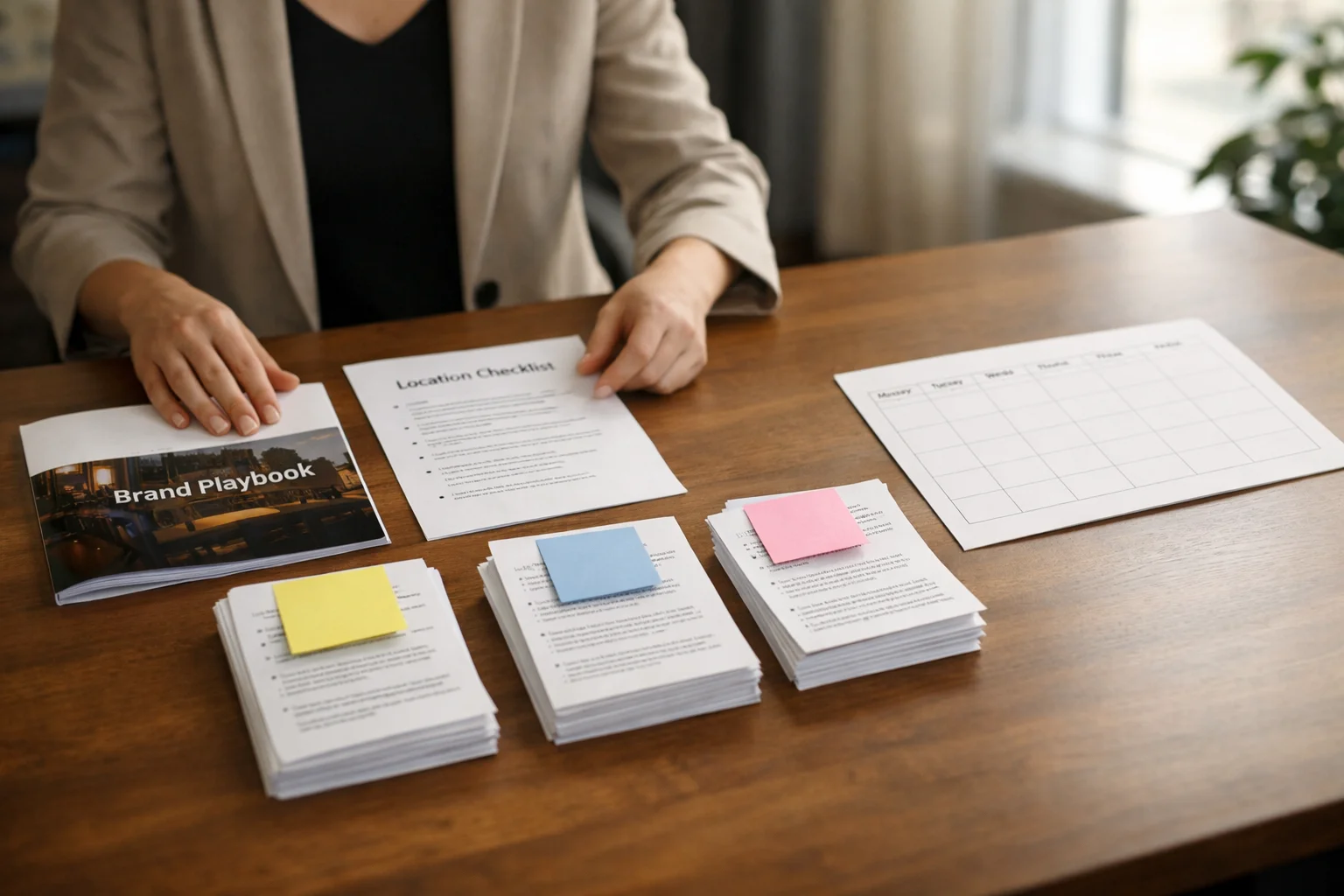
When each location manages its own social media independently without a shared brand spine, the result is diluted brand meaning, inconsistent tone, and guest confusion about what the restaurant group actually stands for. Multiple restaurant locations on social media without central governance produce as many brand identities as there are location managers. The fix is a one to two page brand playbook defined quarterly by central: one positioning sentence, three to five stable pillars, ten to fifteen repeatable post formats, tone rules, claim boundaries, and reply escalation rules. That playbook reduces daily decisions across every location.
Mistake 2: No Weekly Local Truth Submission Ritual
Over-centralisation — where central creates all content without verified local inputs — produces content that feels detached or inaccurate. Posts about dishes that are sold out, promos that have ended, or hours that have changed create public contradictions that erode guest trust. The fix is a weekly local truth submission ritual where each location provides three to five verified inputs: approved photos, real FAQs from DMs and calls, one or two review themes, and one operational update covering any hours exception, closure, or menu change. Locations do not invent campaigns — they supply truth. This ritual is the operational engine of franchise social media management at scale.
Mistake 3: No QA Gate Before Scheduling
Managing multiple restaurant locations on social media fails fastest on preventable inaccuracies — and a QA gate is the single control that stops them before they go public. Without it, posts about sold-out items, expired promotions, or incorrect hours publish automatically and create disputes, complaints, and trust loss that require reactive correction. Minimum QA checks must confirm that hours and policy references are current, availability and promo dates are valid per location, no sensitive guarantees around allergens or dietary claims are present, no invented specifics such as unverified awards appear, and visuals match caption claims with no outdated menu items shown.
Mistake 4: Approvals Scattered Across Email, DMs, and Text
Scattered approvals create version confusion, duplicated edits, and missed publish windows — the core bottleneck of franchise social media management for growing restaurant groups. When “who approved this?” is a recurring question, rework expands and calendar predictability collapses. The fix is one approval channel per location, one place where the final version lives, tracked feedback not scattered across platforms, a time-boxed approval SLA of around 48 hours, and a contract-dependent exception rule for non-response. Governed approvals protect the publish window and protect restaurant brand consistency at every location.
Mistake 5: Promos Pushed Everywhere Despite Menu and Stock Differences
Pushing identical promotional content across all locations without verifying local availability is one of the most damaging mistakes in multi location restaurant marketing. A guest who sees a promoted dish and travels to a location where it is unavailable or priced differently experiences a direct brand contradiction — and that experience becomes a review. The fix is to treat menu availability and promotional validity as location-level truth inputs that must pass the QA gate before scheduling. One brand spine is shared; local accuracy is non-negotiable.
Mistake 6: Reputation Replies Without Escalation Rules
For multiple restaurant locations on social media, review and comment replies are the most public trust signal — and without escalation rules, one risky reply at one location becomes brand-wide evidence. A four-tier reply governance model keeps responses safe across every account: four to five star safe reviews can be drafted using approved reply components and one verified local detail; two to three star mixed reviews require a manager check before publishing; and sensitive cases involving safety, allergens, health claims, discrimination, legal threats, or refunds must escalate to central or corporate only, with no location-level response permitted. This protects restaurant brand consistency where guests pay the most attention.
Mistake 7: No Feedback Loop From Reviews and DMs Into Content
When reviews and DM questions are not fed back into the content system, the same guest objections and uncertainties repeat week after week without being addressed. Multiple restaurant locations on social media that convert recurring review themes and frequent DM questions into what-to-expect posts and FAQ content reduce guest friction proactively — instead of managing it reactively through complaint responses. The fix is a simple weekly learning ritual: tag recurring questions and review themes per location, assign one content response per theme, and update the local truth library so next week’s posts reduce that uncertainty at the source.
Comparison: Centralised vs Decentralised vs Governed Hybrid
The operating model choice for multiple restaurant locations on social media determines whether multi location restaurant marketing stays consistent as the group grows.
A fully centralised model produces a consistent brand voice but slower local truth updates, making content feel detached or inaccurate during local events, menu changes, or hours exceptions. A fully decentralised model allows local authenticity but creates high drift risk, inconsistent quality, and uncontrolled review replies — the opposite of restaurant brand consistency at scale.
The governed hybrid model is the recommended approach. Central governs pillars, templates, QA, approvals, reporting, and sensitive reply escalation. Locations supply verified truth inputs and operate within defined local posting slots and engagement boundaries. The outcome is scalable franchise social media management with controlled risk — a brand that feels local and consistent simultaneously, across every market in the US, UK, and Canada.
For an authoritative overview of how consistent local profiles improve restaurant visibility, see Google Business Profile — How to improve your local ranking on Google.

Where Automation Supports Multiple Restaurant Locations on Social Media
Multi-location operators often want restaurant brand consistency without requiring every general manager to log in daily. In that context, automation adds genuine value when it enforces the operating model — consistent publishing, consistent tone, and governed reputation handling — rather than replacing the operating model with volume.
Consider two scenarios. A US casual dining group with eight locations finds that each location manager is spending 45 minutes daily on social media tasks with inconsistent results. After installing a governed hybrid with a set-once automation system, all eight accounts publish to a shared brand spine with location-specific truth inputs, and daily manager time drops to a 10-minute weekly input submission. A UK restaurant franchise managing five sites struggles with Google review replies that vary in tone and risk level by location. A centrally governed reply system standardises responses across all five accounts and routes sensitive reviews to central for approval — without requiring a dedicated social media hire.
Tinda AI (https://tinda.ai/) is positioned as a “Trusted Identity Nurturing Digital Assistant” and a “set once, done-for-you brand management system for social media.” After a one-time setup, Tinda AI extracts brand identity, tone, and positioning from the business website; creates consistent social media content including text, images, and short-form video; publishes across platforms automatically; responds to Facebook and Instagram comments; responds to Google reviews with brand-safe replies; repurposes Google reviews into social media posts; and provides insights to improve brand trust and visibility.
For more information on relevant features, see:
- Tinda AI – Automated Social Media
- Tinda AI – Google Review Automation
- Tinda AI – Automatic Comment Responder
- Tinda AI – Insights & Analytics
FAQ
How do you manage multiple restaurant locations on social media without losing local authenticity?
Managing multiple restaurant locations on social media without losing local authenticity requires a governed hybrid: central pillars, formats, QA gates, and approvals — combined with a weekly verified local truth submission from each location covering hours, photos, FAQs, and review themes. Central governs the brand; locations supply the accuracy.
What should be centralised in multi location restaurant marketing?
In multi location restaurant marketing, centralise the brand playbook covering pillars, templates, tone rules, and claim boundaries; the QA gate and approval matrix; reporting and performance tracking; and all sensitive-topic escalation including allergen, legal, and safety-related review replies. These controls protect restaurant brand consistency across every account.
What should be localised in franchise social media management?
In franchise social media management, localise hours exceptions, sold-out items, local events, location-specific photos, and DM-sourced FAQs — submitted weekly as verified inputs under central brand rules. Locations do not create brand strategy; they supply the truth that keeps central content accurate and relevant per store.
How do you manage multiple restaurant locations on social media when menus differ by region?
When menus differ by region, keep one brand spine for positioning, pillars, and formats — but treat menu availability and promotional validity as location-level truth inputs that must pass the QA gate before scheduling. A post about a dish unavailable at a specific location must never publish to that location’s account.
What is the clearest sign multiple restaurant locations on social media are being managed well?
The clearest sign multiple restaurant locations on social media are being managed well is a consistent scheduled runway of two to four weeks ahead across all accounts, a declining rate of location-specific complaints about inaccurate posts or hours, consistent review reply times across every profile, and no location publishing content that contradicts the central brand playbook.
Conclusion
Managing multiple restaurant locations on social media becomes predictable when treated as operational discipline: one brand spine, weekly local truth inputs, QA gates, a governed approval matrix, a locked scheduled runway, and reputation escalation rules. That governed hybrid model is what makes multi location restaurant marketing scalable while protecting restaurant brand consistency across US, UK, and Canada locations.
If your locations feel inconsistent online, start by implementing the weekly local truth ritual and a QA gate first. Once inputs and governance are stable, automation can extend the system across every platform — and every location reflects the same brand promise without requiring daily central oversight or daily location logins.